
Mainland vs Free Zone vs Offshore: Which UAE Jurisdiction Suits UK Entrepreneurs?
The UAE has emerged as one of the most appealing places for British business owners who want to go global. With no personal income tax, company-friendly regulations, and a strategic position between Europe, Asia, and Africa, the UAE presents huge opportunities for development.
However, among the most crucial decisions to make when launching a business in the UAE is choosing the right jurisdiction. Firms can be established on the mainland, in a free zone, or as an offshore company, with each choice having its own advantages, restrictions, and regulatory obligations.
UK business owners interested in getting the maximum return on their investment need to know the distinctions between the three.
What are the UAE’s principal jurisdictions for business?
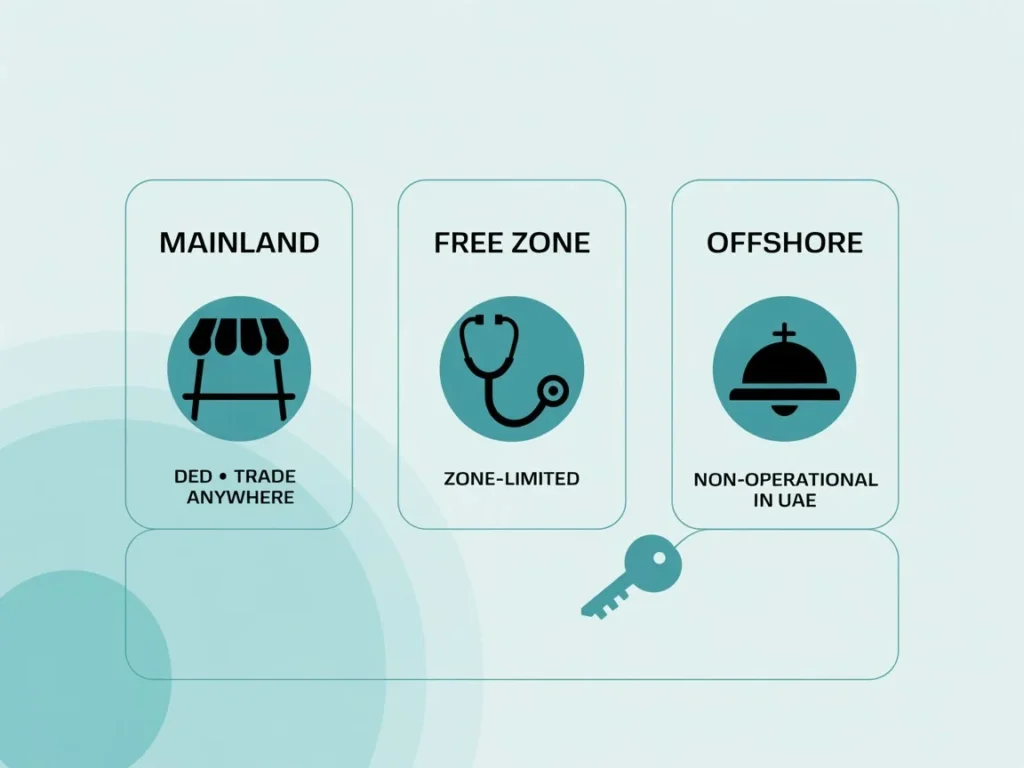
Simply put, the UAE provides three types of business jurisdictions where firms can be established.
1. Mainland: The businesses there are governed by the Department of Economic Development (DED) of the emirate and may trade within the UAE and abroad without any hindrance.
2. Free Zone: The firms are established within specified regions that have full foreign ownership and tax breaks, although their activities are typically limited to their zone or global markets.
3. Offshore: The companies are non-resident entities used essentially for global investments, asset protection, and wealth management, but not to carry out business within the UAE.
The decision between these three jurisdictions is not merely a formality, it determines how your business can do business, hire, navigate tax regulations, and grow.
For UK business owners who are considering whether they wish to access the UAE’s home market, do business internationally, or organise their wealth, this choice is crucial.
What does setting up a mainland company in the UAE mean?
When you incorporate a mainland company, you are effectively signing up with the DED of the emirate where you wish to conduct business, for example, Dubai or Abu Dhabi. A mainland license provides you with the flexibility to trade within the UAE and beyond without any limitation.
In contrast to free zone or offshore organisations, which have geographically or operationally restricted scope, mainland companies are deemed the most flexible. They are especially appealing to those setting up businesses in sectors like retail, hospitality, healthcare, building, or property, where direct contact with the local market is critical.
What are the advantages of a mainland company for UK business owners?
One of the most significant benefits for British entrepreneurs establishing a mainland company is that the requirement for an old-style local Emirati partner has been removed. Most commercial activities have had 100% foreign ownership since 2021, making the investors more in control. Mainland companies also have full access to the UAE market and can deal directly with government contracts and tenders. Mainland firms also provide scalability. No limits exist on the number of visas a firm may apply for, as long as they rent adequate office space.
For UK business leaders looking to gain credibility in the local market, forming a mainland company tends to imply commitment and long-term presence, facilitating the winning of client trust and opening bank accounts.
What are the downsides or drawbacks of a mainland business?
While its flexibility makes it appealing, establishing a mainland company is more expensive than free zone companies. The entrepreneur needs to factor in the cost of an office, staff visas, and more rigorous compliance procedures like regular audits and compliance with employment legislation.
In contrast to some free zones, which permit virtual or communal offices, mainland companies often need actual office space, which drives up overhead costs. For strapped UK startups, such costs can be a determining factor.
What is a UAE free zone company, and how does it operate?
Free zones were created for the purpose of drawing foreign investors through the offering of a business-friendly atmosphere. Every free zone exists as an autonomous authority, granting licenses and governing the companies under its jurisdiction. Free zones are usually industry related. Dubai Multi Commodities Centre (DMCC), for instance, is in vogue for trading enterprises, whereas Dubai International Financial Centre (DIFC) and Abu Dhabi Global Market (ADGM) deal in financial services under English common law.
For UK entrepreneurs, free zones are particularly attractive as they marry affordability with simplicity. They provide several options for licensing, low levels of bureaucracy, and frequently enable companies to begin operations without a large initial outlay on office accommodation.
What attracts UK startups and SMEs to free zones?
Free zones represent the holy grail for small and medium businesses as well as startups. The largest reason is that it is cost-effective, establishing in a free zone tends to cost less upfront than the mainland.It also has 100% foreign ownership, customs duty exemption within the free zone, and profit repatriation. For British entrepreneurs operating consultancy businesses, e-commerce websites, or fintech ventures, free zones offer an efficient route to establish their business with less regulatory burden.
Another advantage is flexibility. Most free zones have shared or virtual offices, allowing lean startups to start without large costs associated with infrastructure. The incorporation process is also easy, with most free zones having dedicated customer service to assist entrepreneurs through licensing, visas, and banking.
What are the disadvantages of a free zone company?
The only disadvantage of a free zone business is that it cannot do much in the UAE domestic market. The only way a free zone company can sell directly on the mainland is to appoint a distributor or local agent, which costs money and creates dependency. Visa allocations are also based on the amount of leased office space, which may limit growth for very fast-growing businesses.
Additionally, although free zones have a simplified setup procedure, banks are wary when handling free zone companies, particularly virtual office-based ones. This can complicate the opening of a corporate bank account compared to that of a mainland company.
What is an offshore company in the UAE?
Offshore entities have a totally different function. They are not intended for the running of businesses but for the protection of assets, wealth management, and international holding structures. Well-known offshore jurisdictions are RAK International Corporate Centre (RAK ICC) and JAFZA Offshore.
Offshore companies, unlike free zone or mainland companies, are not allowed to rent office facilities in the UAE or employ staff. Their function is usually to hold intellectual property rights, handle international assets, or handle international trade without having a physical presence in the UAE market.
Why would UK entrepreneurs establish an offshore company in the UAE?
For most UK business owners, UAE offshore companies are appealing for estate planning and tax structuring. Offshore companies enable investors to hold worldwide assets under a UAE-based firm, benefiting from the nation’s robust banking infrastructure and extensive network of double taxation agreements.
Offshore companies are also confidential since shareholder information is not made public, and they are usually utilised to safeguard family assets or facilitate intellectual property rights.
What are the restrictions of offshore companies?
The largest restriction is that offshore companies cannot carry out business activities in the UAE. They cannot lease office space, purchase visas, or be involved in local contracts.
Moreover, although offshore structures have tax advantages, they are usually subject to stricter examination during corporate bank account applications, with banks requiring clean documentation to satisfy international anti-money laundering requirements.
How do taxes vary among mainland, free zone, and offshore companies?
Taxation is another aspect that UK business owners need to consider carefully. Mainland companies are liable to the UAE’s 9% corporate tax on earnings over AED 375,000, and VAT at 5% is applied to most transactions. Free zone businesses can avail themselves of corporate tax relief where they generate qualifying income and satisfy substance tests, but revenue from mainland activities can continue to be taxable.
Offshore businesses, as non-resident entities, are generally excluded from UAE corporate tax, although they would be required to adhere to international tax reporting systems like CRS and FATCA.
Which UAE jurisdiction is the best place for UK entrepreneurs operating in various sectors?
The appropriateness of each jurisdiction will generally be dependent on the industry. Mainland companies are best suited to sectors that need direct local interaction, like retail, hospitality, education, or healthcare. Free zones are suitable for consulting companies, e-commerce operators, fintech businesses, and international trading companies that do not need to operate locally in the UAE.
Offshore entities are optimal for holding assets, wealth management, or setting up international investments.
How much does it cost to set up a mainland, free zone, or offshore company in the UAE?

Fees are substantial based on the jurisdiction. Mainland setup cost starts from £5,320 (AED 25,000) or more, based on activity and office requirements. Free zone packages begin at £2,418 (AED 12,000) and usually come with visa allocations and shared offices and thus may be an economic choice for start-ups.
Offshore firms are usually the most affordable, starting from £2,015 (AED 10,000) as they have no physical presence.
Which UAE jurisdiction offers the easiest process for opening a corporate bank account?
Banking is a priority for UK business owners in the UAE, and account opening varies by jurisdiction. Mainland companies can easily open accounts since banks perceive them as being strongly based locally, however, if a business performs more than one business activity, banks need to conduct deeper due diligence.
Free zone companies can also easily open accounts, especially with banks based in free zones that offer customised banking products for free zone businesses. Banks may ask for proof of real operations, particularly if the company maintains only a flexi-desk license. Offshore companies are the most challenged, with banks asking for heavy documentation to establish legitimacy and stop abuse.
What are the visa and residency advantages of each territory?
For business owners intending to reside and work within the UAE, visa eligibility is an important consideration. Mainland businesses provide a degree of flexibility, with visa numbers based on office size. Free zone companies have smaller numbers of visas allowed, normally ranging from one to six, except where larger office space is taken on.
Offshore companies do not issue visas, thus making them unsuitable for business owners requiring residency in the UAE.
Which jurisdiction is most suitable for UK entrepreneurs looking for long-term development in the UAE?
For long-term growth, the most scalability and potential for local integration are offered by mainland companies. Free zones continue to be a great option for SMEs, startups, and those companies that are chiefly international market oriented. Offshore companies, as helpful as they are in structuring and asset protection, are not for operational expansion.
UK business owners should thus align their long-term business objectives with the jurisdiction that is best placed to provide the most enduring framework.
Final Thoughts
Selection between mainland, free zone, and offshore jurisdictions is not just a financial decision, it is a business strategy that determines the manner in which a business will be conducted in the UAE.
For UK business owners, the mainland offers the greatest access to the market and long-term credibility, whereas free zones provide value for money and convenience for startups and international ventures. Offshore firms are the best choice for managing wealth and worldwide asset protection.Ultimately, the most suitable jurisdiction will rely on your business objectives. If the intention is to trade domestically and grow in the UAE, the mainland is best.
For an affordable international hub, free zones are the future. And for maximizing global investment or asset structuring, offshore entities are most advantageous. With proper planning and professional advice, UK entrepreneurs can unlock the true potential of the UAE’s vibrant business economy.
Seek our professional on-the-ground guidance, contact us via mail at info@radiantbiz.com or WhatsApp & call us at +44 7398 573313!
